


Compare proportion, profile and finish
Shaker Cabinet Styles
Explore classic, transitional, slim and contemporary Shaker cabinetry—and understand how rail width, edge detail, overlay, finish and hardware change the character of the same five-piece door.
Simple construction leaves proportion exposed
What Makes a Cabinet Door Shaker?
A Shaker cabinet door is built around a recessed center panel framed by two vertical stiles and two horizontal rails. That description sounds simple, but the finished appearance changes dramatically with rail width, center-panel construction, inside-edge detail, outside edge, finish, overlay and hardware.
MDI evaluates the complete elevation—not just a single sample door—because a profile that looks balanced on a base cabinet may feel different across tall pantry doors, narrow wall cabinets, appliance panels and wide drawer fronts.
Details That Define the Style
- Width and proportion of stiles and rails
- Flat, veneered or engineered center-panel construction
- Square, eased, beveled or detailed inside edges
- Paint, stain, wood species and grain direction
- Full-overlay reveals and door-to-door spacing
- Hardware scale, orientation and placement
The main Shaker design families
Classic, Transitional and Slim Shaker Profiles
Shaker is a design language rather than one fixed rail dimension. The right version should relate to the architecture, cabinet sizes, finish and desired visual weight.
Classic Shaker
Regular-width rails create familiar structure and work well in traditional, coastal, farmhouse and enduring transitional interiors.
Refined Transitional Shaker
Controlled proportions and subtle edge details keep the five-piece construction while reducing visual heaviness.
Slim Shaker
Narrow rails create a cleaner architectural grid suited to contemporary kitchens, vanities, bars and built-ins.
Rail width controls visual weight
Regular Shaker vs. 3/4-Inch Slim Shaker
These matched cabinet details use the same color, layout, countertop and hardware so the rail-width difference is easy to see. Both are true five-piece, full-overlay Shaker fronts—not inset cabinetry and not slab doors with routed rectangles.

Regular-Width Shaker
Substantial stiles and rails make the five-piece frame a clear part of the design. The profile feels established, balanced and comfortable with transitional architecture, taller doors and traditional trim.
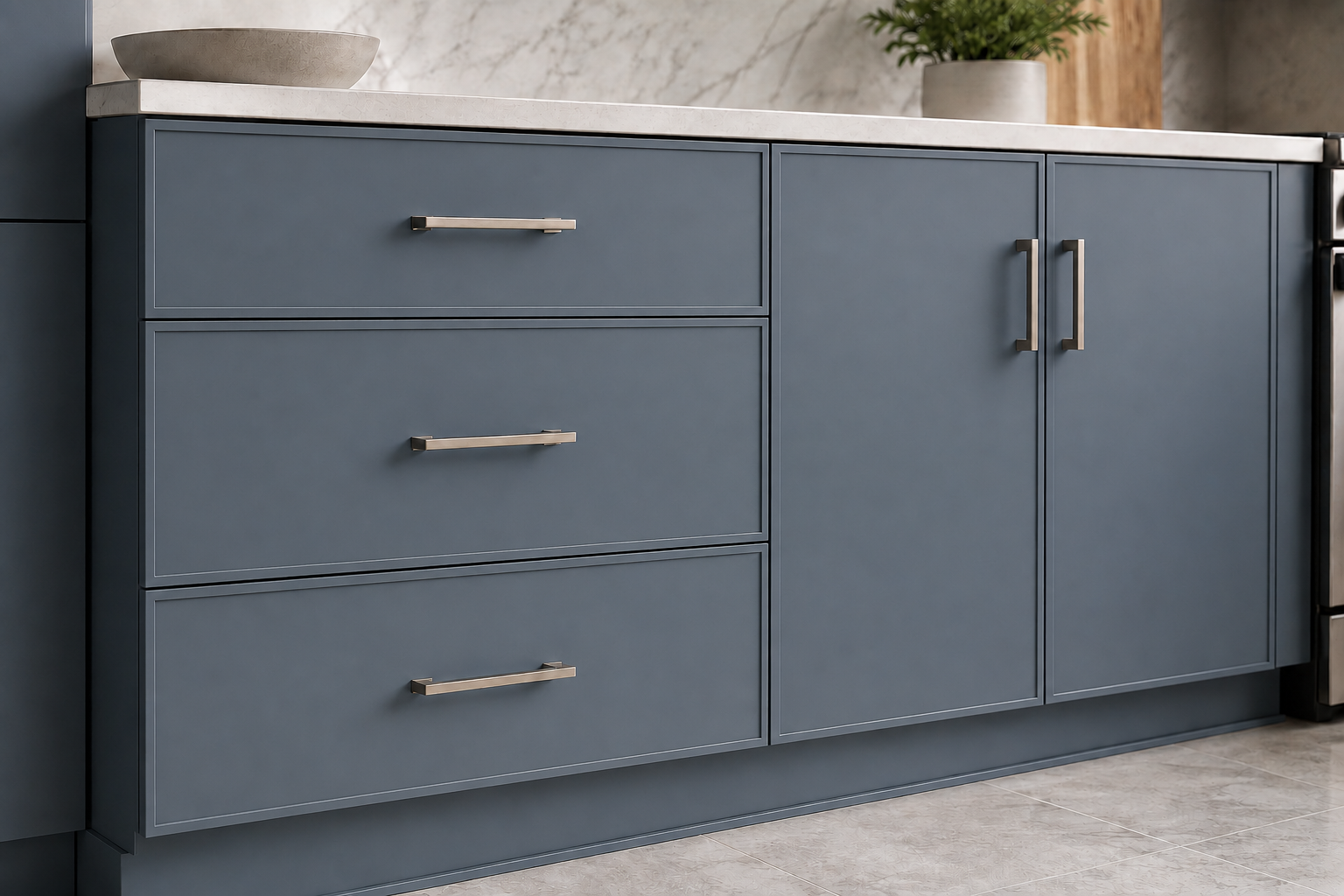
3/4-Inch Slim Shaker
True 3/4-inch face rails enlarge the recessed center panel and create a lighter, more architectural grid. The narrower frame looks distinctly contemporary and demands precise sizing and hardware placement.
Choose Regular Shaker When
- The home has transitional or traditional architecture
- Tall doors need stronger visual proportion
- Crown and light rail are part of the elevation
- A painted or stained finish should feel enduring
Choose 3/4-Inch Slim Shaker When
- The design direction is distinctly contemporary
- Clean horizontal and vertical lines are the priority
- Hardware and reveals can be precisely coordinated
- The room benefits from a lighter visual frame
Construction changes the finished door
Painted, Stained and Engineered Shaker Doors
Painted Shaker
Paint emphasizes the geometry and offers broad color flexibility. Material selection and joinery must account for normal wood movement and visible joints.
Stained Wood Shaker
Stain reveals species, grain and color variation. Door parts should be selected and oriented so the grain reads intentionally across the elevation.
Engineered Components
High-quality engineered panels and stable substrates can support flatter painted surfaces and predictable performance when correctly specified.
Overlay is separate from door style
Full-Overlay Shaker Cabinetry
Shaker describes the door profile. Overlay describes how the door sits on the cabinet. MDI's luxury imagery and design work use full-overlay cabinetry, where doors and drawer fronts cover most of the cabinet face and create narrow, consistent reveals.
Full overlay gives both regular and slim Shaker doors a clean built-in appearance. The plan must still account for adjacent doors, fillers, finished ends, corners, appliance panels, trim, crown, light rail and hardware clearance.
Review Cabinet Filler Panels, light-rail moulding, or crown moulding details.
See the complete MDI collection lineup
Explore Every Shaker Cabinet Collection
Each collection interprets the Shaker framework differently through rail width, edge detail, finish options and overall visual weight. Compare the profile first, then review available cabinet sizes, accessories and construction.
Catalina Shaker
A traditional Shaker profile with a subtle bevel for a tailored transitional appearance.
Slim Shaker
Ultra-thin 3/4-inch rails and stiles create the cleanest, most contemporary Shaker profile in the lineup.
Maui Shaker
A standard Shaker frame with outer-cove and inner-ogee detailing for a refined coastal or transitional look.
Simple Shaker
A true square-edge standard Shaker profile with flat inner edges and clean, versatile proportions.
Escada Shaker
Inner and outer cove detailing adds dimension while keeping the recognizable five-piece Shaker framework.
One profile must work across the whole room
Shaker Doors on Drawers, Pantries and Appliances
Door style cannot be chosen in isolation. A regular Shaker frame may need adjusted proportions on a shallow drawer front, while a slim profile must remain structurally believable on very tall or narrow doors. Appliance panels, pantry doors and stacked wall cabinets add more scale changes.
Hardware should land on real operable fronts, clear adjacent doors, and maintain a consistent visual rhythm. Fixed fillers, decorative end panels and trim should never receive meaningless handles.
Elevation Review Checklist
- Three-drawer banks remain balanced and usable
- Tall pantry doors keep believable rail proportions
- Narrow doors do not become visually cramped
- Hardware clears rails, edges and adjacent fronts
- Fixed end panels remain free of false hardware
- Appliance panels align with surrounding cabinetry
Select the style through the complete design
Shaker Cabinet Style Planning Process
Define the Architecture
Identify whether the room should feel classic, transitional, coastal, contemporary or distinctly modern.
Compare Real Profiles
Review regular and slim rails, edge details, finishes, door construction, drawer fronts and tall-door proportions.
Build the Elevation
Coordinate doors, drawers, appliances, fillers, finished ends, crown, light rail, toe kicks and hardware.
Review in 3D
Confirm visual weight, clearances, color balance, sight lines and cabinet functionality before ordering.
See MDI's 3D Cabinet Design Process or plan custom kitchen cabinetry.
Shaker cabinet style questions
Shaker Cabinet Styles FAQs
What is the difference between classic Shaker and slim Shaker cabinets?
Classic or regular Shaker uses wider stiles and rails for a more established frame. Slim Shaker narrows the frame and enlarges the center panel, creating a cleaner and more contemporary appearance.
Are Shaker cabinets traditional or modern?
They can be either. Rail width, edge detail, finish, overlay, hardware, trim and surrounding architecture determine whether a Shaker kitchen feels traditional, transitional or modern.
Are MDI Shaker cabinets full overlay?
MDI's featured Shaker designs use full-overlay doors and drawer fronts for narrow, consistent reveals and a clean built-in appearance. Exact overlay and construction vary by selected cabinet collection.
Do slim Shaker doors work on every cabinet size?
Not automatically. Very narrow, short or tall fronts require careful proportion, stable construction and hardware placement. The entire elevation should be reviewed rather than applying one rail dimension blindly.
Can MDI help compare Shaker cabinet collections?
Yes. MDI can compare profiles, finishes, cabinet construction, door proportions, storage needs, appliance conditions, trim and budget, then review the selected style through the complete 3D cabinet layout.
Choose the profile through the whole elevation
Find the Right Shaker Cabinet Style
Share the room, measurements, inspiration, finish direction and appliance plan. MDI will help compare Shaker profiles and define the next design step.