

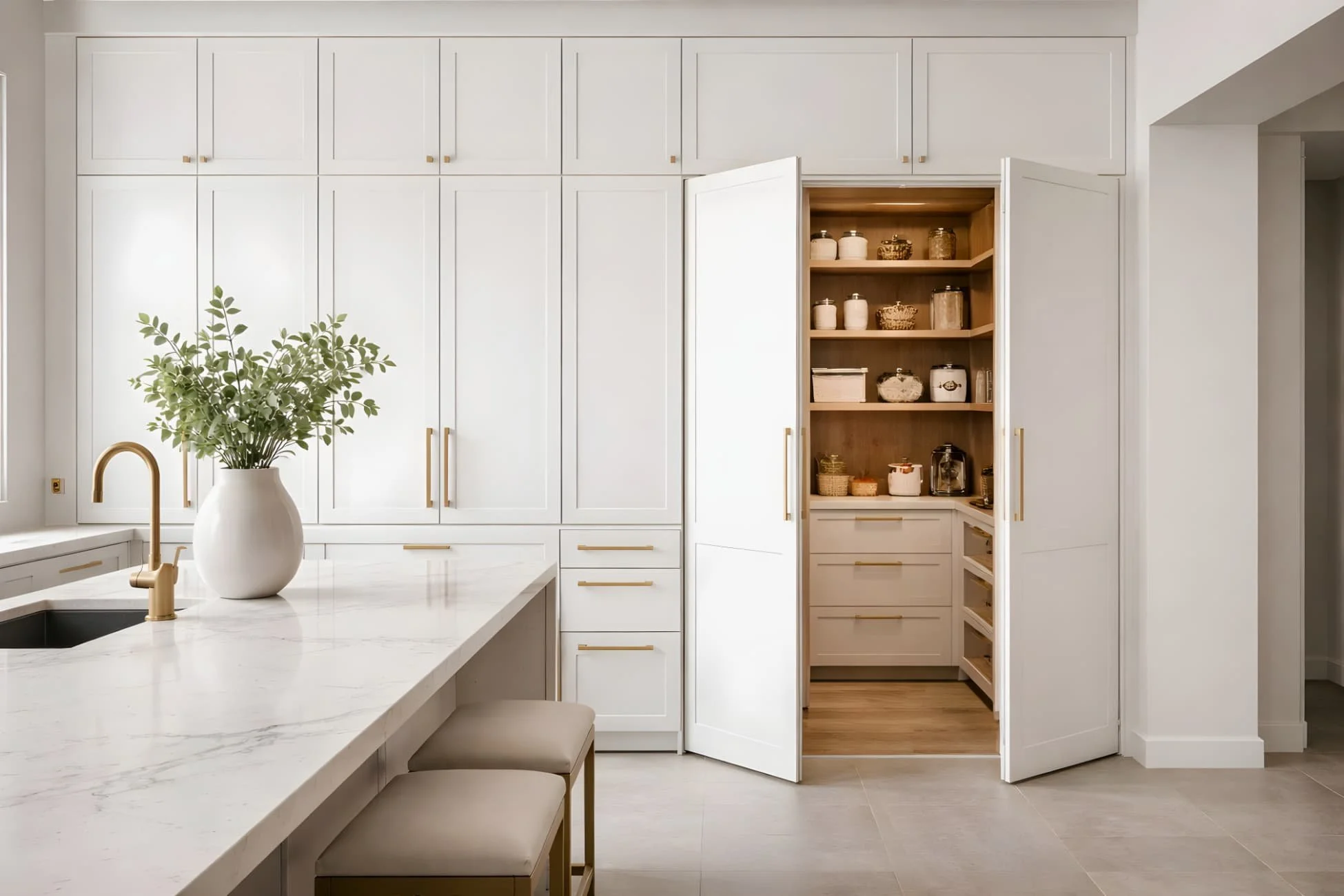
Concealed Storage · Custom Cabinetry
Hidden Walk-In Pantry Cabinets
Create a clean, uninterrupted cabinetry wall while gaining an entire room of organized storage behind a concealed, cabinetry-matched entrance.
Seamless Outside · Functional Inside
What Makes a Pantry Entrance Disappear?
A hidden pantry uses a full-height concealed door that aligns with the surrounding cabinetry. Matching panels, consistent reveals, coordinated rails and stiles, and carefully selected hardware allow the opening to read as part of the cabinet elevation.
Matched Door Profile
The pantry entrance coordinates with the surrounding cabinet style, finish, proportions, and panel arrangement.
Consistent Reveals
Carefully planned spacing keeps the concealed opening aligned with adjoining doors, fillers, and finished panels.
Proper Door Hardware
The size, weight, swing, and frequency of use determine the hinge and support requirements.
Millwork Transitions
Ceiling, wall, floor, and cabinet transitions are planned so the entire elevation finishes cleanly.
Storage Planning
Design the Room Behind the Door
Interior Pantry Features
The best layout depends on what the pantry must store and how frequently each item is used.
- Adjustable open shelving
- Base cabinets and countertops
- Pull-out storage and deep drawers
- Vertical tray and baking-sheet dividers
- Small-appliance and serving storage
Access & Daily Function
The concealed door still needs to function comfortably as a frequently used room entrance.
- Clear, practical door swing
- Comfortable passage width
- Accessible switches and lighting
- Ventilation and electrical planning where required
- Flooring and threshold coordination
Design Before Construction
Plan the Concealed Pantry in Three Stages
Review available depth, wall conditions, circulation, door swing, and the size of the pantry room.
Coordinate the concealed opening with cabinet widths, door profiles, fillers, finished ends, and ceiling transitions.
Finalize cabinet components, door hardware, interior storage, electrical needs, framing, and installation responsibilities.
Common Questions
Hidden Walk-In Pantry FAQ
Can a hidden pantry match any cabinet style?
Many cabinet styles can be coordinated with a concealed pantry entrance, but the door proportions, available panels, hardware, surrounding cabinet layout, and opening size must be evaluated together.
Can an existing pantry door be converted into a hidden cabinet door?
Sometimes. The opening, framing, clearances, wall alignment, flooring, and surrounding cabinetry must support the added door thickness and weight. A site-specific review is required.
Do hidden pantry doors use regular cabinet hinges?
Not necessarily. Because concealed pantry doors are typically larger, heavier, and used as passage doors, they may require specialized concealed hardware and reinforced support.
Turn a Cabinet Wall Into a Hidden Entrance
Discuss a concealed walk-in pantry, custom kitchen cabinetry, and 3D layout planning with MDI Luxury Cabinetry.