

Frame the appliance without blocking it
Refrigerator End Panels
Use correctly sized finished panels, fillers, bridge cabinets, and clearances to integrate a refrigerator into the cabinet elevation while preserving ventilation, service access, and full door operation.
The panel is small; its consequences are not
A Finished Side With a Technical Job
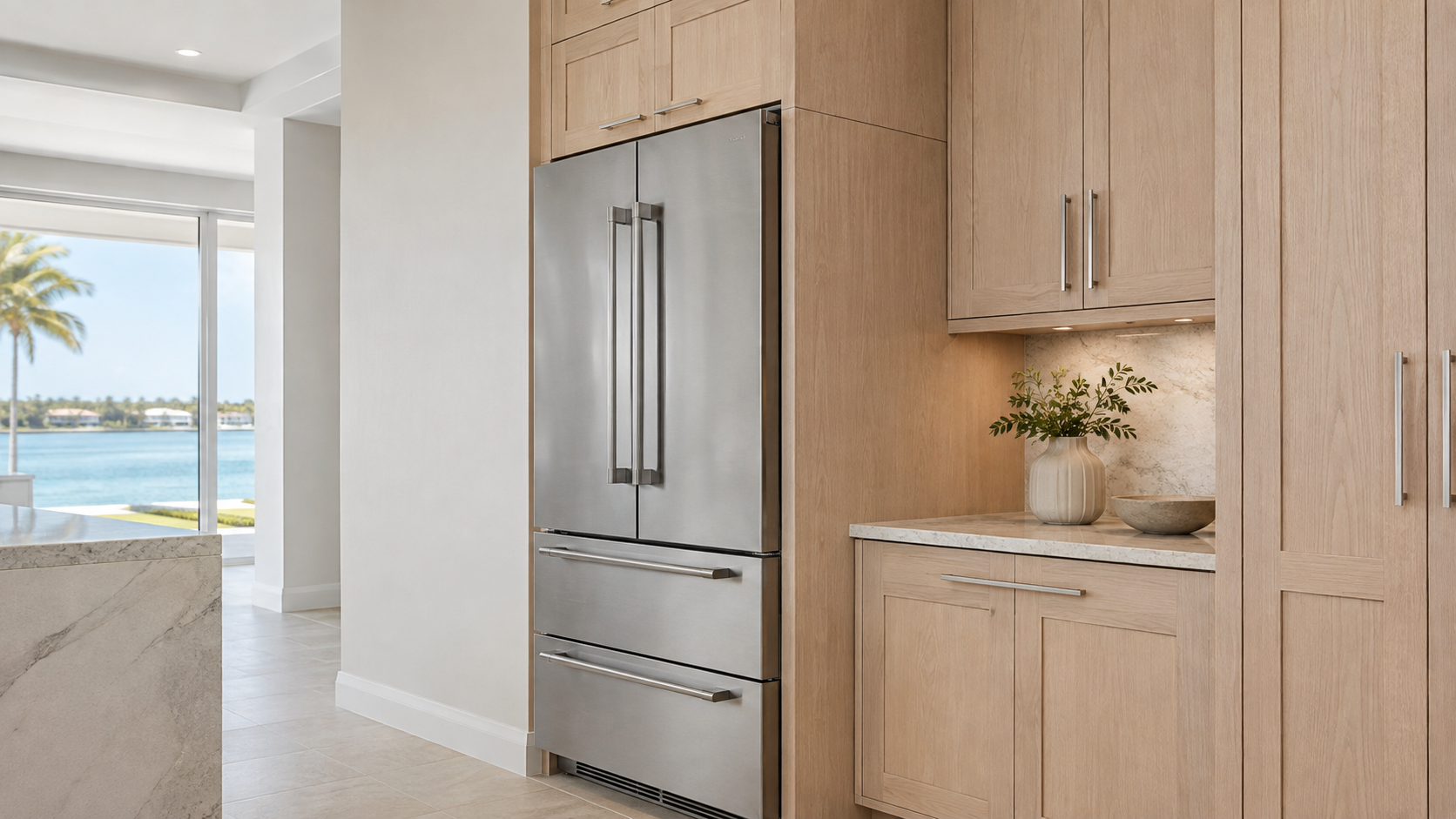
A refrigerator end panel hides the appliance side, supports the visual cabinet enclosure, defines the bridge cabinet, and creates a clean transition to an adjacent countertop or open room. Its depth, height, thickness, finish, and position must agree with the exact refrigerator.
If the panel is too shallow, the refrigerator projects awkwardly. If it is too deep or the filler is too small, doors and handles may strike the panel before opening fully. MDI plans the end condition from appliance specifications rather than appearance alone.
What the Panel Must Coordinate
- Overall refrigerator width, case depth, door depth, and height
- Door hinge path, handle projection, and required opening angle
- Manufacturer side, rear, top, and ventilation clearances
- Bridge-cabinet depth, support, alignment, and access
- Adjacent countertop edge, backsplash, fillers, and toe kick
- Finished face, exposed edge, grain direction, and installation sequence
One panel detail changes with the appliance type
Refrigerator Panel Conditions
Freestanding, counter-depth, built-in, and panel-ready refrigerators do not use the same enclosure dimensions. The appliance specification controls the cabinet solution.
Freestanding Refrigerator
A finished side panel can visually contain the appliance, but the cabinet depth must acknowledge the deeper case, doors, handles, rear clearance, and ventilation requirements.
Counter-Depth Refrigerator
A shallower body can align more closely with surrounding cabinetry, while the doors still project enough to clear panels, handles, walls, and adjacent counters.
Built-In Refrigerator
Built-in units require exact opening dimensions, air movement, power, water, anti-tip provisions, service access, and manufacturer-specific panel or trim conditions.
Panel-Ready Refrigerator
Custom appliance panels add another layer of dimensions, weight, reveals, handle placement, hinge limits, and alignment with adjacent cabinet doors.
Depth must be read from the side
Panel Depth, Door Projection & Handle Clearance
The visible cabinet face is not the only datum. Refrigerator doors often project beyond the case so they can pivot without binding. Handles project farther still, and some doors widen or move outward through the opening arc.
The end panel and any filler must be positioned so the refrigerator can reach the opening angle required for drawers, bins, shelves, ice makers, and service access. A panel that looks perfectly flush when closed can still prevent normal use.
Operational Checks
- Both refrigerator doors opened through their full working range
- Freezer drawers extended without striking adjacent handles
- Interior bins and shelves removable at the available door angle
- Panel edge clear of hinges, gaskets, and factory trim
- Countertop and backsplash outside the handle swing path
- Nearby pantry doors and drawers tested simultaneously
Finish the entire refrigerator bay
Bridge Cabinets, Fillers & Countertop Terminations
Bridge Cabinet Above
The upper cabinet should align with the refrigerator enclosure, remain accessible, provide appropriate depth, and avoid interfering with ventilation or appliance service.
Filler Beside the Appliance
A deliberate filler creates handle and hinge clearance, absorbs field variation, and keeps the refrigerator from binding against a panel, wall, or tall cabinet.
Counter Ending at the Panel
Stone, backsplash, upper cabinets, lighting, and base cabinetry should terminate into the panel with controlled reveals and a practical finished edge.
The panel should belong to the elevation
Material, Grain & Alignment
A refrigerator panel may match painted cabinetry, repeat a natural-wood tall wall, or introduce a deliberate material transition. Whatever the finish, the grain direction, exposed edge, sheen, panel thickness, toe-kick condition, and alignment with nearby rails should be intentional.
Painted End Panels
Painted panels should match door color and sheen while maintaining crisp edges and enough thickness to read as part of the cabinetry—not drywall.
Wood-Veneer Panels
Veneer direction and sequence should support the tall vertical form, with exposed edges and adjacent doors coordinated to avoid random grain changes.
Crown & Ceiling Transitions
When the refrigerator bay reaches the ceiling, the panel, bridge cabinet, riser, and crown must terminate together without floating trim or unsupported returns.
Use the exact appliance—not a generic rectangle
Refrigerator End-Panel Design Process
Confirm the Appliance
Use the current manufacturer specification for case dimensions, doors, handles, hinges, clearances, ventilation, power, water, and service access.
Map the Surroundings
Measure walls, floors, ceilings, counters, backsplash, adjacent cabinets, openings, and traffic that affect the refrigerator bay.
Test Full Operation
Model door swing, freezer travel, bin removal, handle clearance, filler width, panel depth, bridge cabinetry, and nearby cabinet movement.
Release the Details
Confirm panel material, thickness, edge treatment, finish, grain, fillers, toe kick, trim, installation sequence, and appliance responsibility.
See How MDI Uses 3D Cabinet Design or continue to tall pantry cabinets.
Refrigerator panel questions
Refrigerator End Panel FAQs
What is a refrigerator end panel?
A refrigerator end panel is a finished vertical cabinet component used to conceal the exposed side of a refrigerator, define the appliance enclosure, support the surrounding elevation, and create a clean transition to adjacent cabinetry or countertops.
How deep should a refrigerator end panel be?
Panel depth depends on the exact refrigerator case, door projection, handles, required clearances, adjacent cabinetry, and desired visual alignment. It should be sized from the manufacturer specification and the full operating geometry.
Does a refrigerator need a filler beside the end panel?
Often, yes. A filler may be required to provide hinge and handle clearance, absorb wall variation, allow door swing, and keep the appliance from binding against the panel or adjacent cabinetry.
Can a countertop terminate into a refrigerator end panel?
Yes. The countertop, backsplash, base cabinet, and upper cabinet should meet the panel with coordinated depths, finished edges, appropriate support, and controlled reveals.
Can MDI review refrigerator panels and door swing in 3D?
Yes. 3D cabinet design can review panel depth, fillers, bridge cabinets, refrigerator doors, freezer drawers, handles, ventilation, counters, walls, nearby cabinetry, and complete operating clearances.
Design the enclosure around the real appliance
Plan a Refrigerator End Panel That Fits and Functions
Share the refrigerator model, kitchen dimensions, surrounding cabinetry, and design direction. MDI will help define the enclosure and next design step.