

Hello, World!

The surface carrying everything inside the drawer
Drawer Bottom Thickness
Compare 1/4-, 3/8-, and 1/2-inch drawer bottoms—and learn why material, groove support, drawer span, slides, and intended load matter alongside thickness.
Small dimension, meaningful difference
Why Drawer-Bottom Construction Matters
A drawer bottom carries cookware, dishes, utensils, pantry goods, tools, clothing, and everything else placed inside the box. Thickness influences stiffness, but it does not work alone. The panel material, drawer width and depth, groove engagement, side construction, slide rating, and expected load determine how the complete drawer performs.
A thicker bottom generally resists flexing better across the same unsupported span. Still, a properly designed thinner bottom can serve an appropriate light-duty drawer, while a poorly supported thick panel does not automatically create a superior drawer.
Evaluate the Complete Drawer
- Actual bottom-panel thickness and material
- Whether the panel is captured in grooves
- Drawer width, depth, and unsupported span
- Drawer-side material and joinery
- Slide type, extension, and load rating
- Expected contents and daily use
Three thicknesses readers commonly encounter
1/4 vs 3/8 vs 1/2-Inch Drawer Bottoms
One-quarter and one-half inch are common comparison points in cabinet specifications. Three-eighths inch is also used in some drawer systems as a middle thickness. Always confirm the selected collection's actual specification.
Visual comparison from left to right: 1/4 inch, 3/8 inch, and 1/2 inch. Photography is illustrative; verify manufacturer specifications for the selected cabinet line.
1/4-Inch Bottoms
A common thinner specification that can serve standard household drawers when the panel material, groove support, drawer span, and expected contents are appropriate.
3/8-Inch Bottoms
Used in some drawer systems as a middle specification, offering more section thickness than 1/4 inch without reaching a full 1/2 inch.
1/2-Inch Bottoms
A substantial premium specification that provides greater stiffness across the same span and is well suited to drawers expected to carry heavier contents.

Thickness must be supported correctly
A Captured Bottom Works as Part of the Box
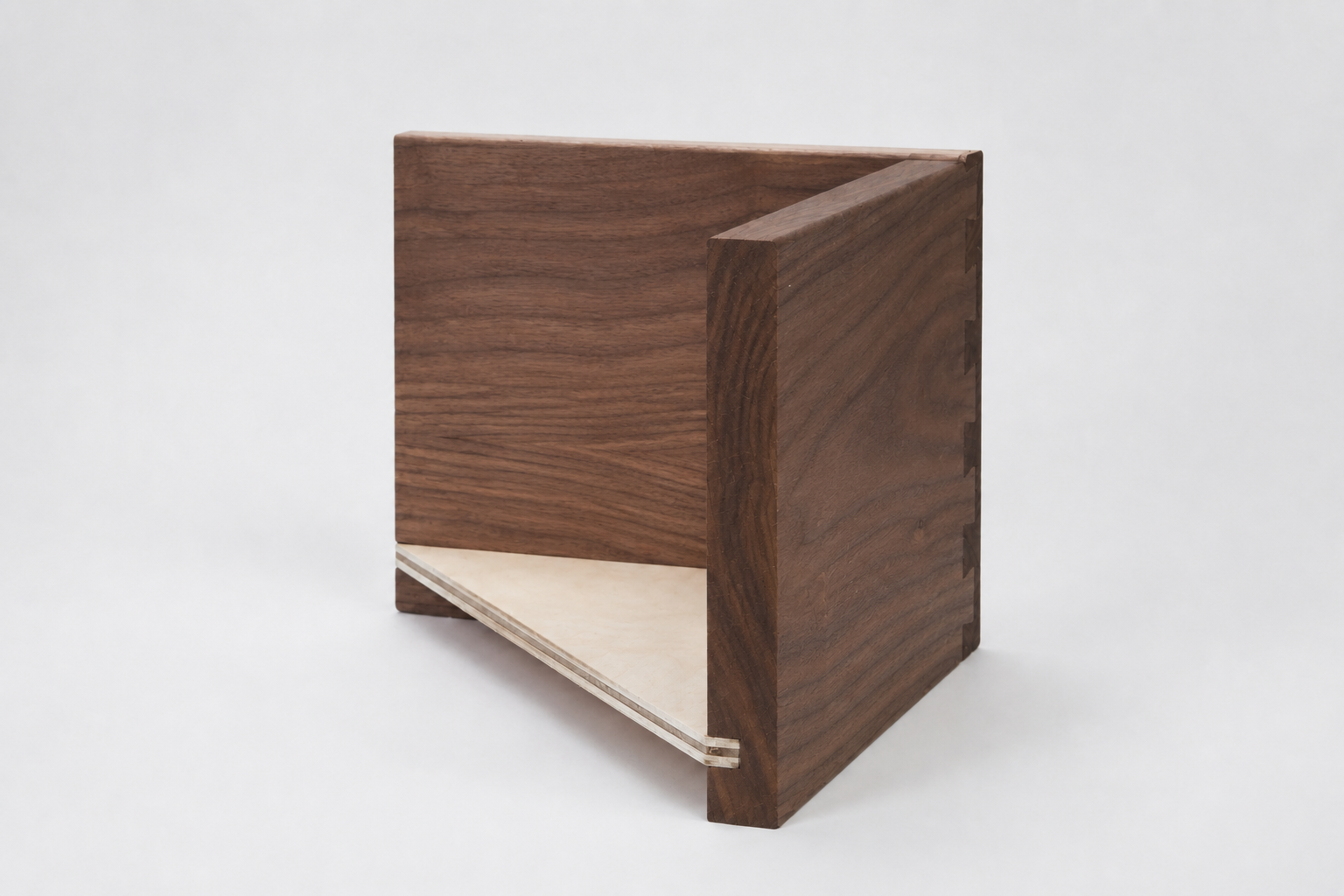
In quality drawer construction, the bottom panel is typically housed in grooves in the drawer sides and front rather than simply fastened beneath the box. The groove supports the panel around its perimeter and allows the drawer components to work together.
The walnut cutaway makes the relationship easy to see: the lighter plywood bottom is held within the darker drawer members. Groove depth, remaining material below the groove, rear construction, and assembly accuracy all affect the finished result.
- Panel seated consistently in the groove
- Sufficient material below the groove
- Square assembly without twist
- Secure rear-panel relationship
- Correct bottom size without forced bowing
Thickness is only one line of the specification
What Can Change Real-World Performance?
Panel Material
Plywood, engineered panels, and other materials differ in stiffness, uniformity, moisture response, and fastener behavior.
Drawer Span
A wider or deeper drawer creates a larger span and can place more demand on the same bottom thickness.
Expected Load
Flatware and linens do not challenge a drawer like cookware, pantry goods, tools, or other concentrated weight.
Drawer Slides
Slide design, extension, installation, adjustment, and rating must complement the drawer rather than become the weak link.
Compare Soft-Close Drawer Slides and understand plywood cabinet construction.
Ask for the specification before ordering
How to Compare Cabinet Drawers
Do not stop at “dovetail drawer” or “soft close.” Ask how the drawer is built as a system. A useful comparison includes the sides, bottom, joinery, slides, clearances, and the exact construction supplied in the collection being quoted.
- What is the actual drawer-bottom thickness?
- What material is the bottom panel?
- Is the bottom captured in grooves?
- How are the front, sides, and back joined?
- Which slides are supplied and what access do they provide?
- Do wide drawers use the same construction?
Continue the Cabinet-Quality Review
Dovetail Drawer Construction — understand the drawer-box joints.
Soft-Close Drawer Slides — compare undermount and side-mount systems.
Cabinet Quality Comparison — review the complete cabinet system.
Cabinet Collections — compare available MDI lines and specifications.
Drawer-bottom questions
Drawer Bottom Thickness FAQs
What drawer-bottom thickness is most common?
One-quarter and one-half inch are common comparison points across cabinet and drawer-box specifications. Three-eighths inch is also used in some systems. The actual thickness varies by manufacturer, collection, drawer size, and construction method.
Is a 1/2-inch drawer bottom always better than 1/4 inch?
A 1/2-inch bottom is generally stiffer across the same span, but thickness is not the only quality factor. Material, groove support, drawer dimensions, joinery, slides, assembly, and expected load must also be considered.
Where is a 3/8-inch drawer bottom used?
Some drawer systems use a 3/8-inch panel as a middle specification between 1/4 and 1/2 inch. Availability depends on the manufacturer and product line.
Should a drawer bottom be captured in grooves?
Grooved construction supports the panel around the drawer perimeter and integrates it with the box. Groove depth, material remaining below the groove, rear construction, and assembly accuracy remain important.
What should I ask when comparing cabinet drawers?
Ask about bottom thickness and material, drawer-side material, joinery, groove construction, drawer dimensions, slide type and rating, full-extension access, and whether specifications vary among cabinet sizes.
Compare what is behind the drawer front
Choose Cabinetry by the Complete Construction
MDI Luxury Cabinetry can help compare cabinet collections, drawer construction, hardware, design requirements, and the components needed for a complete kitchen.