


Interlocking hardwood joinery built for daily use
Dovetail Drawer Construction
See how dovetail pins and tails strengthen a cabinet drawer—and compare MDI-manufactured custom drawer boxes with the dovetail drawers supplied in applicable RTA cabinet collections.
A joint designed to resist separation
What Is a Dovetail Drawer?
A dovetail drawer uses a series of precisely machined wedge-shaped pins and tails to connect the drawer front, sides, or back. The pieces mechanically interlock, so everyday pulling force is resisted by the shape of the joint instead of relying only on staples, screws, or adhesive.
That visible interlocking pattern is associated with premium cabinetry because it combines strength, alignment, and craftsmanship in a high-use part of the cabinet. The joint still depends on accurate machining, square assembly, suitable hardwood sides, a properly supported bottom, protective finishing, and correctly installed slides.
The Complete Drawer System
- Dovetail pins and tails fitted tightly together
- Hardwood drawer-box sides sized for the application
- Drawer bottom captured and supported correctly
- Square assembly without twist or racking
- Protective interior and exterior finish
- Slides matched to drawer size, access, and intended load
Why the geometry matters
How Dovetail Joinery Strengthens a Drawer
Opening a loaded drawer repeatedly places force where the drawer front and sides meet. Dovetail geometry spreads that force through multiple interlocking surfaces and helps resist the front pulling away from the box.
Mechanical Interlock
Wedge-shaped pins and tails lock together instead of depending entirely on fasteners.
Pull-Apart Resistance
The joint orientation directly resists the repeated outward force placed on the drawer front.
Square Assembly
Accurate machining and assembly help maintain the box shape needed for proper slide operation.
Visible Craftsmanship
Clean, consistent dovetails make the construction quality easy to inspect inside the cabinet.
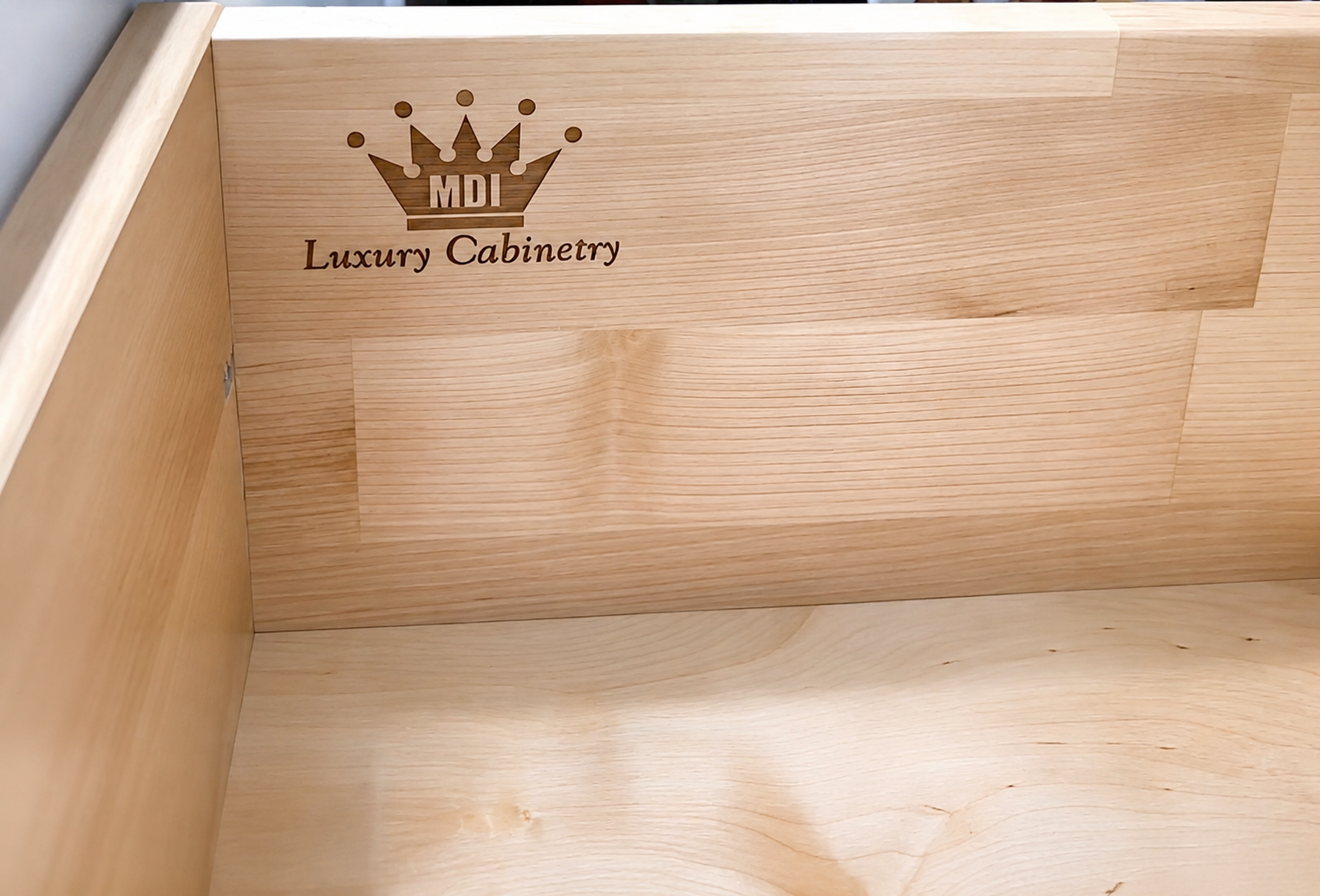
Authentic MDI craftsmanship
Our Registered Mark on the Work
This is a real MDI-manufactured custom dovetail drawer—not recreated logo artwork. The enhanced photograph shows the laser-engraved MDI Luxury Cabinetry crown mark used on our custom cabinetry drawer boxes.
MDI custom drawer boxes are manufactured for our custom cabinetry projects from 5/8-inch birch hardwood and receive a UV-protected clearcoat. Depending on the drawer and its intended application, 1/4-inch or 1/2-inch bottoms are available.
- Real custom drawer manufactured by MDI
- 5/8-inch birch hardwood drawer-box sides
- Traditional dovetail corner joinery
- UV-protected clearcoat
- Choice of 1/4- or 1/2-inch drawer bottom
- Laser-engraved registered MDI Luxury Cabinetry mark
The trademarked company mark and the actual laser engraving in the wood are authentic MDI assets.
Two distinct cabinetry programs
MDI Custom vs RTA Dovetail Drawers
Both programs use dovetail joinery, but the drawer-box specifications and branding are different. The custom drawer is made for MDI custom cabinetry projects. The RTA drawer is supplied with the applicable factory cabinet collection.
MDI Custom Cabinetry Drawer
Custom-built for qualifying MDI cabinetry projects.
- Drawer sides: 5/8-inch birch hardwood
- Corner construction: Dovetail joinery
- Finish: UV-protected clearcoat
- Bottom options: 1/4 inch or 1/2 inch
- Branding: Laser-engraved registered MDI mark
RTA Cabinetry Drawer
Supplied with applicable ready-to-assemble cabinet collections.
- Drawer sides: 1/2-inch birch hardwood
- Corner construction: Dovetail joinery
- Bottom: 3/8-inch plywood
- Use: Everyday kitchen and bathroom storage
- Branding: No laser-engraved MDI logo
Different parts, different jobs
Dovetail Is Not the Same as Soft Close
Dovetail describes the construction of the wooden drawer box. Soft close describes the slide hardware that controls the drawer as it closes. A drawer can have dovetail joints without soft-close slides, or soft-close slides on a drawer built with another joint.
A strong complete system can combine both: a square hardwood dovetail box for structure and correctly selected slides for smooth movement, extension, adjustment, and controlled closing.
Dovetail Joinery
How the wooden drawer members connect at the corners.
Drawer Bottom
The panel carrying contents within the drawer box.
Drawer Slides
The hardware supporting and controlling drawer travel.
Do not compare the corner joint alone
Dovetail vs Stapled or Butt-Joint Drawers
| Construction Detail | Dovetail Hardwood Drawer | Basic Stapled or Butt-Joint Drawer |
|---|---|---|
| Corner Connection | Interlocking pins and tails create a mechanical joint. | Square edges depend primarily on fasteners and adhesive. |
| Pull-Apart Resistance | Joint geometry helps resist repeated outward force on the drawer front. | Repeated use can place more direct demand on staples, screws, or adhesive. |
| Inspection | Fit, spacing, gaps, chipping, and machining are visible at the corners. | Fastener placement and edge alignment are the primary visible details. |
| Complete Quality | Still depends on wood, bottom, finish, assembly, and slide selection. | Still depends on panel material, fastening, bottom, assembly, and slides. |

Look beyond the visible joint
What to Inspect in a Dovetail Drawer
A dovetail pattern does not automatically make every drawer equal. Inspect the materials and assembly that allow the box to perform as a system.
- Tight pins and tails without obvious gaps or splits
- Clean machining without chipped hardwood edges
- Square box construction without twist or racking
- Correct drawer-side material and thickness
- Bottom material and thickness suited to the span and load
- Bottom seated consistently in the supporting grooves
- Smooth protective finish on accessible wood surfaces
- Slides installed square, adjusted correctly, and suited to the drawer
Drawer-construction questions
Dovetail Drawer FAQs
Why are dovetail drawers considered premium?
Dovetail drawers use interlocking pins and tails that mechanically resist separation at the corners. The joint is durable, visible, and requires accurate machining and assembly, but complete quality also depends on the drawer-side material, bottom, finish, slides, and installation.
Are dovetail drawers the same as soft-close drawers?
No. Dovetail describes the wooden drawer-box joint. Soft close describes the slide hardware that controls closing movement. A quality drawer system may include both features.
What are MDI custom dovetail drawers made from?
MDI custom cabinetry drawer boxes use 5/8-inch birch hardwood sides, dovetail joinery, and a UV-protected clearcoat. One-quarter-inch and one-half-inch drawer bottoms are available depending on the application.
What are the RTA dovetail drawers made from?
The applicable RTA cabinetry drawers use 1/2-inch birch hardwood sides with dovetail joinery and a 3/8-inch plywood bottom. The RTA drawers do not receive the laser-engraved MDI logo.
Is the engraved drawer shown on this page real?
Yes. The photograph shows a real MDI custom dovetail drawer carrying the laser-engraved registered MDI Luxury Cabinetry mark. It is not a recreated logo illustration.
What should I inspect before comparing dovetail drawers?
Compare joint fit and machining, drawer-side material and thickness, bottom material and thickness, groove support, protective finish, square assembly, slide type, extension, adjustment, and the exact specification supplied with the selected cabinetry.
Continue the cabinet-quality review
See How the Complete Cabinet Works Together
Cabinet Construction
Review the cabinet as a complete structural system.
Plywood Cabinet Boxes
Understand cabinet-box panels, edges, and assembly.
Drawer Bottom Thickness
Compare 1/4-, 3/8-, and 1/2-inch specifications.
Cabinet Quality Comparison
Compare materials, drawers, hardware, and construction.
Compare the actual specifications
Choose the Right Drawer for the Cabinetry
MDI Luxury Cabinetry can help compare custom and RTA cabinet construction, drawer-box specifications, hardware, design requirements, and the components needed for a complete kitchen.