

Cabinetry Guides & Expert Resources
Better Information.
Better Cabinet Decisions.
Practical guidance on cabinet construction, door styles, layouts, ordering, installation realities, custom design, and the details that determine how a finished kitchen performs.
Experience-Based Cabinetry Education
Answers Grounded in How Cabinets Are Actually Built and Installed.
Cabinet decisions affect far more than color. Box construction, door profiles, overlays, fillers, panels, hardware, appliance clearances, room conditions, freight, assembly, and installation all influence the final result.
MDI's resource center helps homeowners compare options, understand specifications, prepare better layouts, and approach online cabinet ordering with fewer surprises.
Start With These Guides
Featured Cabinetry Resources.
These articles answer the questions customers most often face before selecting a collection, approving a layout, or placing an order.
Slim Shaker vs. Traditional Shaker
Compare rail widths, visual weight, design character, and the rooms where each shaker profile works best.
Read the Comparison → Technical SpecificationsHow Maui Cabinets Are Built
Review door construction, plywood cabinet boxes, full-overlay design, dovetail drawers, and undermount hardware.
Review Construction → Design DetailsWhy Some Kitchens Look Custom
Learn how proportions, fillers, panels, moldings, alignment, and transitions separate a designed kitchen from installed boxes.
See What Makes the Difference → Collection GuideChoose the Right Cabinet Collection
Compare style, construction, finish direction, flexibility, project needs, and the best route for your home.
Compare Collections → Online OrderingHow to Buy Cabinets Online
Understand measurements, design support, order review, freight delivery, assembly, and planning before purchase.
Read the Buying Guide → RTA CabinetsAre RTA Cabinets Worth It?
Evaluate quality, construction, value, shipping, assembly, installation, and when RTA cabinetry makes sense.
Explore the Answer →Ready to Move From Research to a Project?
Choose Your Next Step.
Shop Cabinet Collections
Compare Catalina, Slim Shaker, Maui, Simple Shaker, and Escada door styles and finishes.
Explore Collections →Get Layout & Design Help
Turn measurements and ideas into a coordinated cabinet plan before ordering.
Explore 3D Design →Discuss a Custom Project
Plan custom kitchens, closets, vanities, built-ins, and qualifying Florida cabinetry projects.
Contact MDI →Complete Evergreen Article Directory
Browse All 80 Cabinetry Articles.
Every current MDI cabinetry article is linked below so visitors and search engines can reach the complete resource library without depending on pagination or search.
Open the Complete Article Directory
Latest Cabinetry Articles
Continue Into the Full MDI Resource Library.
The live Squarespace blog feed begins directly below this section, with the newest articles first.
↓Find the Cabinetry Answer You Need.
Search all 81 MDI articles or browse by topic. These guides cover cabinet construction, online ordering, custom design, installation, closets, vanities, local projects and the details that shape a successful result.
Featured Guides & New Releases
9 featured articlesBuying Cabinets & RTA Guides
Online ordering and product selectionCabinet Doors, Materials & Construction
Profiles, hardware and technical detailsKitchen Design & Inspiration
Layouts, finishes and architectural ideasCustom Closets & Storage
Organization and built-in storageBathroom Vanities
Vanity design and bathroom storageLocal & Custom Cabinetry
Pinellas County projects and investment guidesProject Planning & Industry Knowledge
Costs, responsibilities and planning realitiesTry a broader term such as “cabinets,” “doors,” “closets,” “installation” or “RTA.”
Ready to Move from Research to a Cabinet Plan?
Send MDI your measurements, appliance information and project goals. Our design team can help you compare collections, review the layout and determine the right cabinetry path.
Wood Cabinet Doors for Pinellas County Homes
Explore wood cabinet-door species, construction, profiles and finishes for Pinellas County homes. Learn how white oak, walnut, maple and painted doors respond to design, natural variation and Florida’s climate.

Wood cabinet doors establish the character of an entire kitchen. Species, grain, construction, profile and finish all influence how the cabinetry looks under Florida sunlight—and how it performs as indoor humidity changes. The right decision begins with understanding the door itself, not simply choosing a color from a small photograph.
What Makes a Quality Wood Cabinet Door?
A quality cabinet door should feel substantial, remain stable and display deliberate craftsmanship at every joint. Many traditional doors use five-piece construction: two vertical stiles, two horizontal rails and a center panel. This allows the components to respond more naturally to environmental changes than a single wide piece of solid lumber.
Accurate construction
Proper joinery, consistent dimensions and a well-fitted center panel help the door stay square while opening and closing smoothly.
Consistent profiles
Door and drawer-front profiles should coordinate throughout the room. A profiled door paired with unrelated slab drawers weakens an otherwise custom appearance.
Appropriate thickness
Many premium cabinet doors are approximately ¾ inch thick. Thickness must work with the hinges, overlay and cabinet construction rather than merely appearing heavy.
Professional finishing
Careful sanding, sealing and topcoating protect the surface while allowing stained wood to retain its depth and natural character.
Popular Wood Species for Cabinet Doors
White oak
White oak has visible grain, natural color movement and a relaxed architectural quality. It works especially well in coastal, transitional and organic-modern Pinellas County homes.
Walnut
Walnut delivers darker color, flowing grain and unmistakable richness. It can create an entire statement kitchen or serve as an accent on an island, bar or built-in.
Maple
Maple has a tighter, smoother grain than oak. Its relatively quiet appearance supports light stains, deeper toning and refined painted applications.
Paint-grade materials
When the goal is an even painted finish, a properly engineered paint-grade door can be a better choice than highly variable natural wood. Material selection should match the intended finish.
*NCO products with natural White Oak, may contain color streaks, spots and color variation from almost white to very dark, is not considered as a defect. No backcharges will be accepted for allowable characteristics in natural White Oak. To avoid these noticeable color and grain variations, please select painted products.*
Stain-Grade Versus Paint-Grade Doors
| Consideration | Stained wood | Painted cabinetry |
|---|---|---|
| Visual character | Highlights natural grain, color movement and individual boards. | Creates a more uniform color and places greater emphasis on the door profile. |
| Best design use | Organic, coastal, traditional and furniture-inspired interiors. | Clean transitional, contemporary and classic kitchens. |
| Natural movement | Small changes in grain and tone remain visible and expected. | Seasonal movement may create fine witness lines near joints over time. |
| Selection priority | Choose the species and grain before finalizing the stain. | Choose stable paint-grade construction and the appropriate sheen. |
Flat, Raised and Shaker Center Panels
Shaker and recessed-panel doors
Shaker doors remain popular because their restrained profile works across several architectural styles. Rail width matters: a traditional Shaker profile feels different from a narrow Slim Shaker design, even when both use the same finish.
Raised-panel doors
Raised center panels introduce additional depth, shadow and furniture-like detail. They suit traditional and elevated transitional spaces when the surrounding mouldings and cabinetry proportions support the added detail.
Applied moulding and detailed profiles
More elaborate door profiles can bring distinction to vanities, bars, libraries and formal kitchens. The detailing should be coordinated with drawer fronts, end panels, crown and architectural millwork so the room reads as one composition.
Explore the available styles through our cabinet collections, or review how door selection fits into complete custom kitchen cabinetry.
Wood Movement in Florida Homes
Wood is hygroscopic, meaning it gains or releases moisture as surrounding conditions change. Air conditioning controls much of a Florida home’s interior climate, but seasonal humidity, construction moisture and prolonged open-door conditions can still affect wood components.
Responsible construction accommodates normal movement rather than pretending it does not exist. Floating center panels, correctly prepared material, proper finishing and stable indoor conditions all contribute to long-term performance.
How to Select Doors for Your Pinellas County Home
- Begin with the architecture. Consider whether the home is coastal modern, transitional, traditional or contemporary before choosing a fashionable door in isolation.
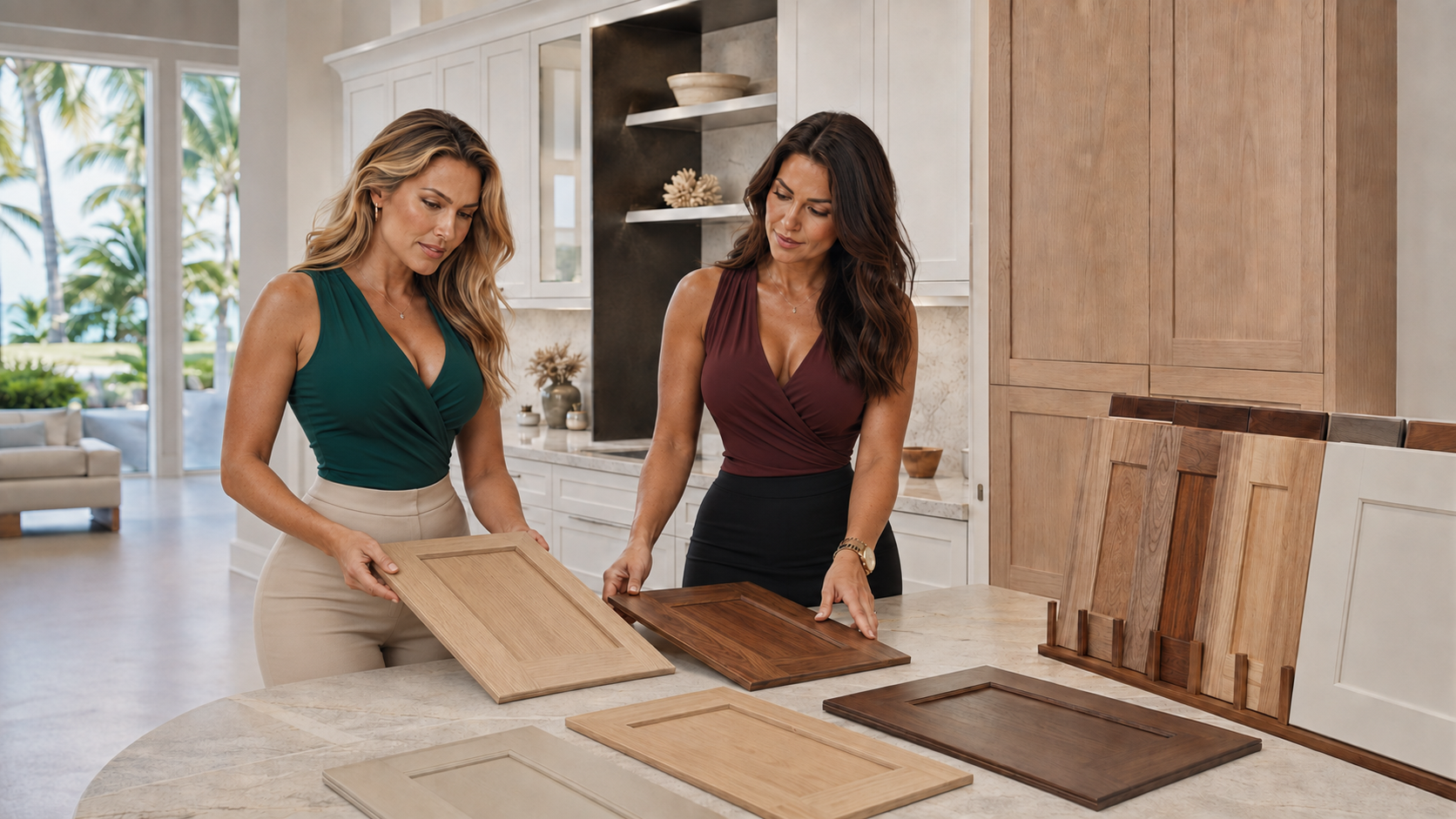
- View full-size samples. Small color chips cannot adequately show rail proportions, center-panel depth, grain movement or finish interaction.
- Evaluate samples vertically. A door lying flat on a table receives light differently than a door installed upright in a kitchen.
- Compare the door and drawer front together. Make sure their profiles, reveals and hardware positions create a coordinated elevation.
- Review the entire cabinet system. Door appearance is only one part of quality. Examine box construction, shelves, drawer boxes, hinges and slides through our cabinet construction guide.
- Approve the design before ordering. A professional layout helps verify door clearances, fillers, appliance spacing and how grain or color transitions travel across the room.
Hardware Should Support the Door
Hardware should complement the wood rather than overwhelm it. Pull length, projection, finish and placement must work with the rail dimensions and door operation. Each operable door or drawer needs accessible hardware, while fixed decorative panels should remain free of unnecessary pulls.
For a clean, current look, MDI Luxury Cabinetry commonly coordinates cabinetry with proportional bar pulls such as the Stanton series by Elements. Final hardware selection should be tested against an actual door sample whenever possible.
MDI Custom Cabinetry and MDI Luxury Cabinetry
MDI offers two distinct hand-built cabinetry lines. MDI Custom Cabinetry provides locally built custom quality comparable to respected custom cabinet builders throughout the area. MDI Luxury Cabinetry is our top-tier line, distinguished by our most exquisite finishes, elevated features, 12¼-inch-deep upper cabinets and the trademarked MDI crown laser-engraved into its premium drawer boxes.
There is no product called “MDI Luxury Custom Cabinetry.” The correct lines are MDI Custom Cabinetry and MDI Luxury Cabinetry. Our design team can help determine which construction level, door style and finish best match the project rather than forcing every homeowner into the same specification.
Wood Cabinet Door Questions
Are solid wood cabinet doors better?
Quality depends on construction, material preparation, joinery and finishing—not simply the words “solid wood.” A well-built five-piece door may use solid-wood rails and stiles with a stable center panel specifically designed to accommodate movement.
What wood is best for coastal Florida cabinetry?
White oak, maple and walnut can all perform well when properly constructed and finished. The correct choice depends on the desired grain, color, door profile and maintenance expectations.
Will every natural wood door match?
No. Genuine wood naturally varies in grain and color. Professional selection and finishing can create a coordinated composition, but natural wood should not look mechanically identical from door to door.
Should I choose painted doors if I want consistent color?
Yes. Painted cabinetry is generally the better direction when highly uniform color is more important than visible grain and natural variation.
Can MDI help me compare door samples?
Yes. MDI Luxury Cabinetry helps homeowners compare door profiles, species, finishes, construction levels and hardware before finalizing a cabinetry order.
Choose Your Cabinet Doors with Confidence
Bring your measurements, inspiration and finish preferences to MDI Luxury Cabinetry. We will help you compare real door samples and develop a coordinated cabinet design for your Pinellas County home.